Three stages. Three outcomes.
- Exposure
- Gaps
- Evidence
See where you stand, close gaps, prove it — in one continuous programme.
Start here
Pick one entry — everything below walks through the full arc.
Fastest
Browser check (no account)
Framework-aligned exposure pass; results can feed Workspace diagnostics later.
Privacy Exposure CheckSnapshot
Posture & radar
Cross-framework posture view — still on this site, no account needed.
PrivacyPosture™ DashboardProgramme hub
Privacy Readiness Workspace
RoPA, compliance tracker, tasks, DSAR/DPIA, reports — Stages 2–3 live here.
Start Privacy Review View pricingRegulatory reviews, MODPA, and KIDS Act tools: Privacy Review catalogue
Turn privacy uncertainty into a clear action plan
Typical blind spots on the left — a grounded operating path on the right. Click any region to open the matching review or resource.
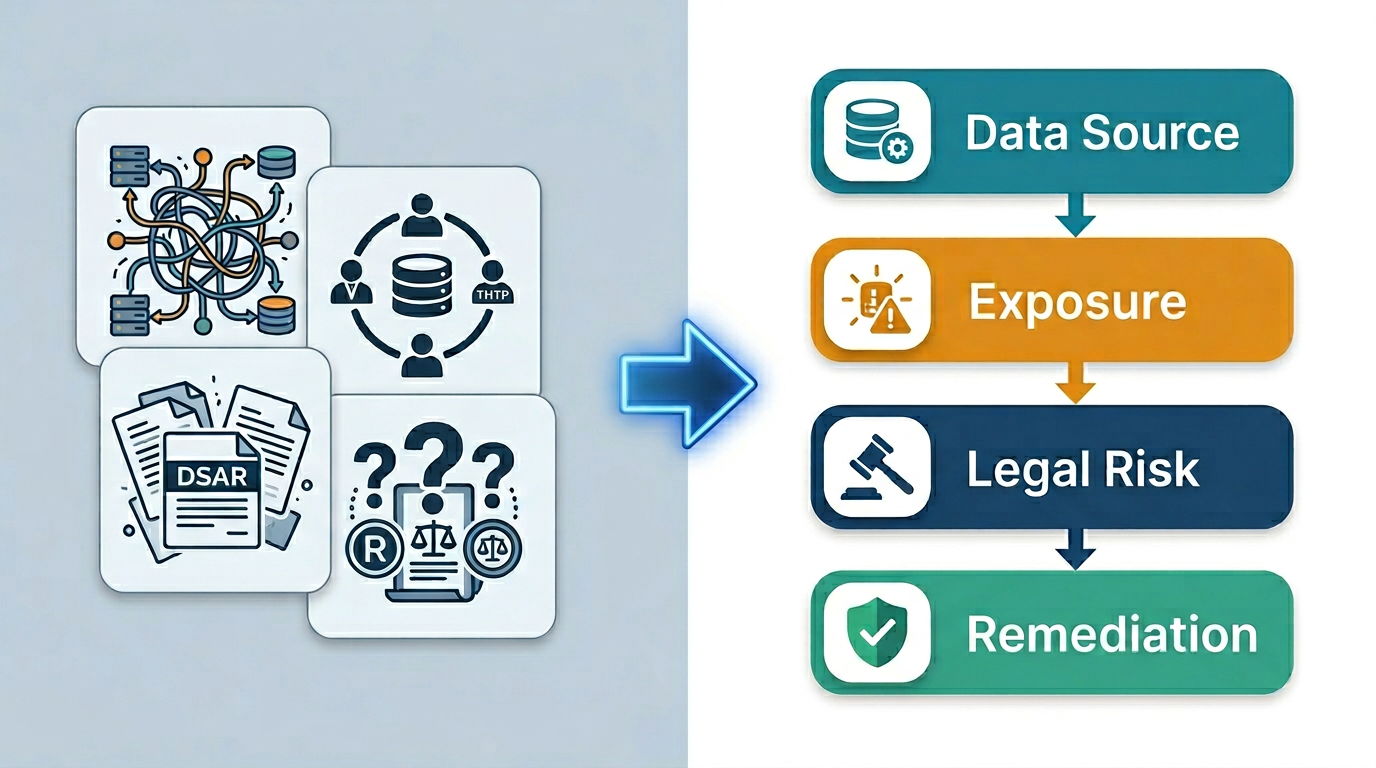
Identify privacy exposure
Know exactly which privacy risks pose the greatest exposure.
Use on-demand posture scoring with optional auto-refresh, regulatory framework lenses, and enforcement signal context to identify which privacy conditions pose the greatest risk to your organization — across systems, vendors, consent, data flows, and governance gaps.
- Refreshable posture scoring with explainable weights
- Risk drivers across consent, retention, access, and transfer
- Regulatory scope mapping (GDPR, CCPA, MODPA, KIDS Act, NIST PF)
- Enforcement signal context — not theoretical scores
Use the Start here choices above for primary CTAs. Stage 1 maps to Privacy Review on this site; guided assessments and deeper diagnostics also run in the Workspace.
Understand Your Compliance Gaps
Know exactly which controls and documentation are needed based on your exposure profile.
Framework-aligned gap analysis that maps your personal data flows, identifies missing controls, and defines exactly what documentation you need — ROPA, DPIAs, consent records, and vendor agreements.
- RoPA processing activities register in Workspace
- DPIA generation aligned to Article 35
- Visual data flow maps across systems & vendors
- Obligation mapping (GDPR / CCPA / NIST PF)
Close the Compliance Gaps
Evidence-based proof of privacy compliance.
Implement prioritized controls, track actions with owners, collect evidence of compliance, and generate audit-ready reports that demonstrate privacy program maturity for regulators, boards, and insurers.
- Risk-driven remediation roadmap with Gantt view
- Evidence collection aligned to real obligations
- Privacy Request Portal — request intake, workflow, and SLA tracking for backend-enabled deployments
- Board & DPA-ready reporting
Where Stage 3 happens
Evidence packs, DSAR workflow, vendor register, and remediation all live in the Workspace — one audit trail for boards, DPAs, and procurement.
- GRC Suite (DSAR / privacy ops) — DSAR intake, workflow, SLA tracking
- Remediation roadmap — owners, due dates, Gantt-style progress
- Reports — board- and regulator-ready summaries
From exposure to defensible decisions
Identify your gaps and risk, understand what to fix, and build evidence aligned with real privacy obligations.
Exposure discovery
See where your organization stands across data flows, vendors, and obligations — before an audit or request forces visibility.
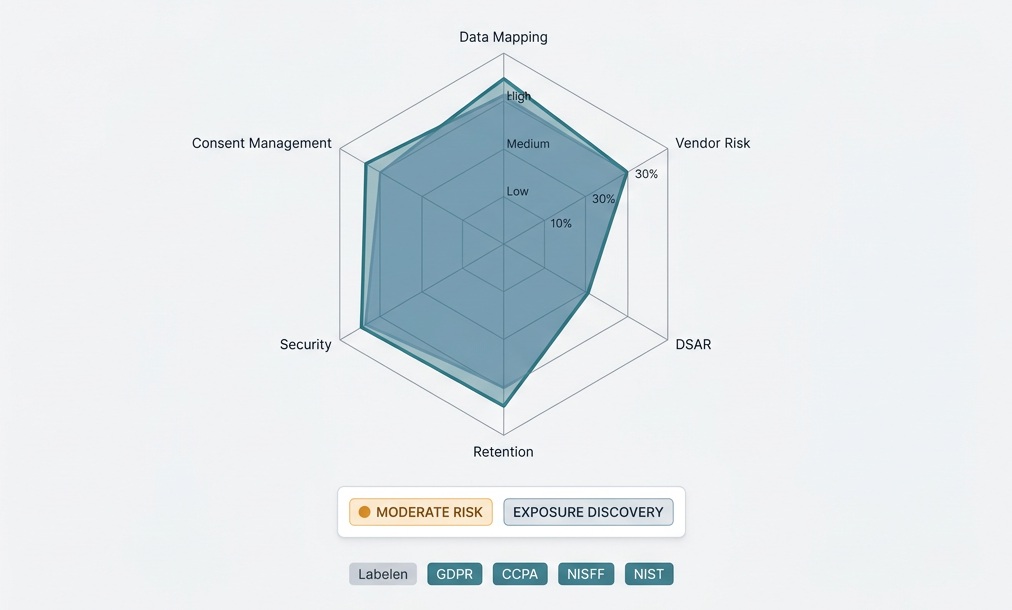
What to fix first
Understand what gaps matter most and what actions reduce your risk — with clear priorities, not checklists.
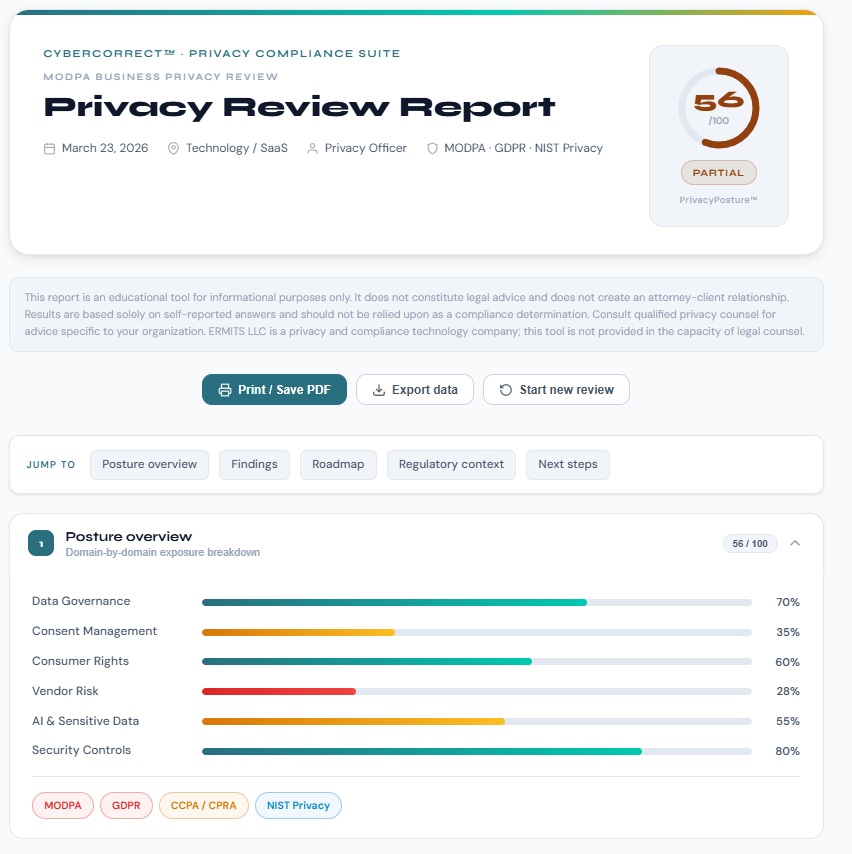
Audit-ready evidence
Build structured records, assessments, and evidence so you can respond confidently to regulators, customers, and internal stakeholders.
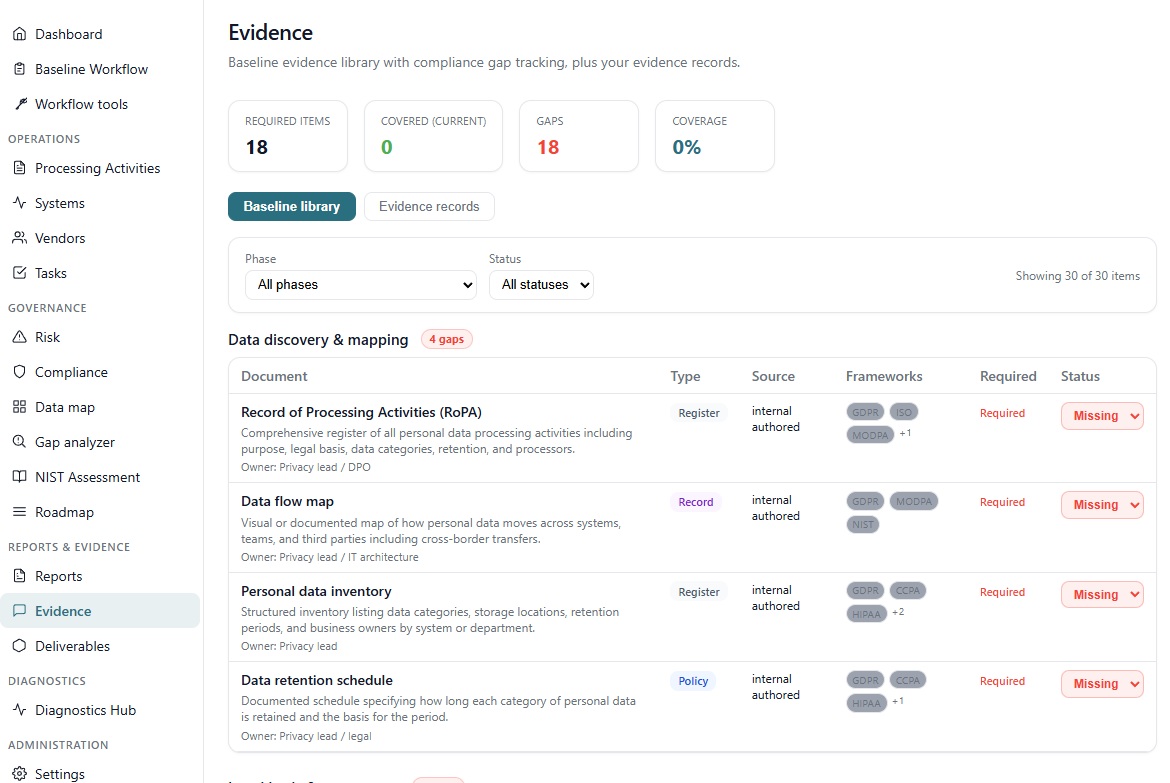
Further reading
How CyberCorrect™ evaluates privacy compliance Evaluates conditions and applies regulatory context to identify where gaps amplify exposure or enforcement risk.
Focus on exposure, documentation gaps, and enforcement risk
CyberCorrect™ evaluates conditions that influence regulatory exposure. The methodology prioritizes understanding how a missing control or undocumented process would look under regulator scrutiny — not just whether a policy document exists.
Prioritization based on regulatory and enforcement logic
Prioritization is based on actual enforcement patterns and regulatory guidance, not generic maturity scores. Recommendations are tied to real GDPR/CCPA enforcement scenarios — not abstract compliance checklists.
Transparent, explainable scoring
The assessment logic is designed to be explainable. DPOs and legal teams can understand why specific conditions matter and how they connect to regulatory obligations — making evidence packs defensible, not just presentable.
See how methodology, data handling, and tool boundaries are documented on the Trust & Transparency page.
Regulatory context, not theoretical risk Assessments draw from actual DPA decisions and enforcement actions — not textbook risk models.
Emphasis on how regulators investigate and fine
The methodology emphasises how regulators actually investigate — not just "control presence." This enforcement-informed approach ensures assessments identify conditions that matter to real DPA investigations and ICO inquiries.
Evolving regulatory landscape awareness
CyberCorrect™'s evaluation framework is updated to reflect changes in GDPR interpretation, CCPA amendments, EDPB guidelines, Maryland MODPA enforcement, the pending KIDS Act package, and new frameworks like the EU AI Act — ensuring assessments stay relevant as the regulatory landscape shifts.